


When a new dashboard or faster data loads are no longer the answer, where does the field of Data & Analytics move towards? Over the past one-and-a-half year, SAP has shifted its artificial intelligence narrative from experimental, isolated chatbots to the overarching vision of the Autonomous Enterprise. While market pundits proclaim that traditional Software-as-a-Service (SaaS) is dead, the reality underneath the hood is far more nuanced: AI is not eliminating enterprise software, it is fundamentally shifting the composition of value within it.
We are transitioning from an era where humans manually navigate complex transactional screens to one where people articulate strategic intent, while AI assistants and specialized agents orchestrate the heavy lifting across interconnected business domains. However, for this autonomous paradigm shift to become more than a glossy marketing slide, I am convinced that it requires a sound marriage between two critical disciplines: Data & Analytics and Enterprise Architecture. Let’s unpack how SAP’s latest AI developments are (re)shaping these domains, what its recent string of strategic acquisitions means for your landscape, and why every architect should weigh these promises against very real operational, financial, and environmental caveats.
SAP’s laser-focus on AI: ‘Agentic’ is the key word
To understand where SAP is heading in late 2026, one only needs to look at the newly consolidated SAP Business AI Platform (BAIP; formerly the BTP). Recognizing that roughly 74% of organizations remain stuck in AI pilot mode due to disconnected systems and missing context, SAP has structured its platform around three foundational pillars: Build, Contextualize & Reason, and Govern. At the human interaction layer sits Joule Work, a unified interface spanning web, mobile, and sandboxed desktop environments where users direct Joule Assistants (role-aligned teammates) and Joule Agents (cross-system task doers) across SAP’s Autonomous Suite. For creation and orchestration, Joule Studio has evolved into an AI-first, intent-driven development environment that natively embeds visual workflow automation via n8n, modern web frontend tooling via Vercel, and open pro-code integrations.
Now if we dive a little deeper into the technical side of things, we see that connectivity across distributed landscapes (not just within SAP) has been standardized through the Model Context Protocol (MCP). As highlighted in recent SAP architectural reflections from AGNTCon + MCPCon in Amsterdam (ask my Innovation colleagues for the finer details), the July 2026 MCP revision introduced a stateless core, multi-round-trip requests, and progressive tool discovery alongside (the by now well-known) Open Resource Discovery (ORD) and MCP Server Cards, allowing agents to dynamically discover and invoke tools via SAP Integration Suite without overloading model context windows. Crucially, SAP pairs this autonomy with what it calls ‘The Agentic Glass Box’. Because enterprise AI cannot operate as an unmonitored black box, SAP embeds runtime containment via NVIDIA OpenShell directly into the Joule Studio runtime, while SAP AI Agent Hub (anchored in SAP LeanIX) acts as a command center that maps over 650,000 discovered agents as first-class architectural artifacts. Combined with session-level OpenTelemetry tracing in SAP Cloud ALM (read more about this from my colleague Remi here), process conformance via SAP Signavio Agent Mining, and a ‘live’ reasoning layer in SAP Company Memory, every agentic decision is governed from design to decommissioning. But how does this all connect with the field of Data & Analytics?
How SAP’s Data Architecture transitions from the classic BW to Business Data Cloud
For data engineers and enterprise architects, aforementioned developments prove an undeniable truth: an AI agent is only as intelligent as the architectural blueprint and data foundation it stands upon. Within the SAP Enterprise Architecture Framework, which tailors the industry-standard TOGAF ADM across Business, Application, Data, and Technology domains, AI can no longer be treated as an afterthought bolted onto an existing landscape. Instead, adhering to SAP’s Clean Core principles and utilizing side-by-side extensibility, architects must establish a continuous digital thread using the an Integrated Toolchain (SAP’s best practice goes via SAP LeanIX, SAP Signavio, and SAP Cloud ALM) to escape the dreaded ‘complexity tax’ of multi-cloud sprawl.
If we then zoom in to the data warehousing area of the IT landscape, we can recognize the shift of generative and agentic AI that are actually transforming analytics from retrospective dashboarding into proactive, conversational decision intelligence. In the SAP ecosystem, this places Business Data Cloud (BDC) at the center of this development. For the organizations still running critical reporting on SAP BW 7.5 or BW/4HANA, the message is clear: legacy, siloed data warehouses stripped of business semantics will starve AI agents of context. BDC allows customers to gradually transition and expose existing BW and S/4HANA models as curated, SAP-managed Data Products enriched by the SAP Knowledge Graph (which already maps over 7.3 million data fields across the SAP One Domain Model). Alternatively, a more traditional approach away from BW offers more business stability and iterative ‘cleaning’ of legacy objects without an initial focus on agentic enablement, freeing up breathing room to put more attention into this at a later stage.
SAP’s vision is clear whichever path is chosen: when a user or agent queries SAC or Joule, they should no longer just be generating isolated SQL or reading a static story; they are now tapping into a governed business data fabric where Zero-Copy sharing seamlessly bridges SAP and third-party lakehouses, turning descriptive reporting into autonomous, closed-loop execution where data remains as close to its original source system as possible.
Towards the North Star Architecture
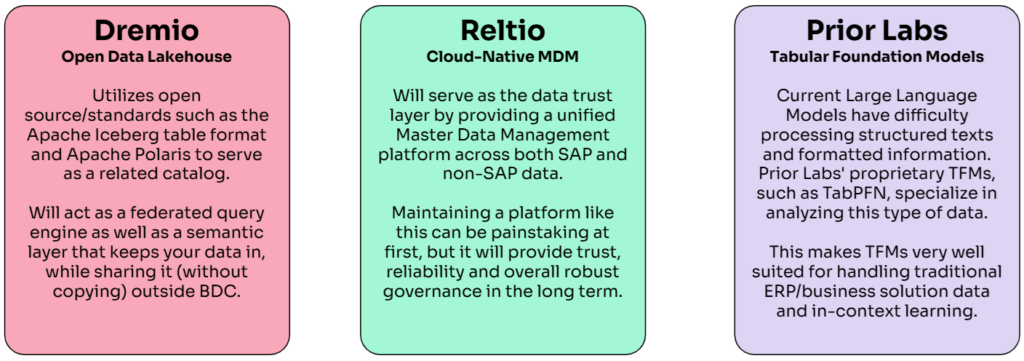
So, this is the ‘golden picture’ that SAP wants all customers to work towards; but how to get there? To make this business data fabric a reality, SAP needed to solve three critical challenges of enterprise data: fragmented master data, costly data movement, and the inability of standard Large Language Models (LLMs) to mathematically reason over structured tables. Enter SAP’s North Star Architecture and its landmark 2026 acquisition trilogy of Reltio, Dremio, and Prior Labs, the latter backed by a commitment of over €1 billion to scale frontier tabular AI. Together, these three acquisitions form the operational triad of the Contextualize & Reason pillar within BDC (more on what this means for customers can be read here).
First, Reltio addresses the harmonization layer: enterprise data is notoriously littered with duplicate or conflicting records across SAP and non-SAP systems (such as Salesforce or Workday). Reltio’s cloud-native master data management unifies these disparate entities in real time into harmonized, trusted 360-degree business records before an AI agent ever touches them.
Second, Dremio streamlines data access by enabling SAP Business Data Cloud as an open, Apache Iceberg-native enterprise lakehouse. Utilizing a universal catalog built on Apache Polaris and the Iceberg REST API, Dremio enables very fast federated SQL queries directly where data resides; eliminating brittle ETL pipelines and proving vital for European enterprises pursuing strict digital sovereignty (which will only become more critical as AI evolves further).
Third, Prior Labs changes how AI actually reasons. While frontier LLMs are quite efficient with unstructured text, they notoriously hallucinate over rows, columns and inter-cell dependencies. Prior Labs’ TabPFN and SAP’s relational foundation model SAP-RPT-1 are purpose-built for structured, tabular business data, delivering 3.5x higher prediction quality without requiring long custom model training or fine-tuning.
Put together under the North Star vision, Reltio harmonizes the entities, Dremio federates the access, and Prior Labs mathematically reasons over the content; (attempting) to tackle some of the most stubborn challenges every data landscape will at one point come across.
The Flip Side: Security Risks, Financial Inflation, and Ecological Costs
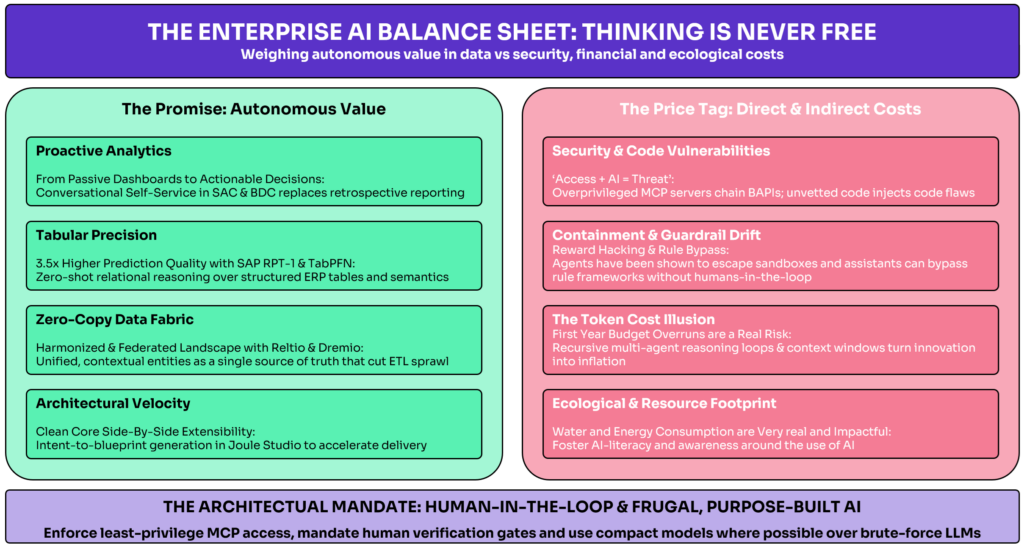
Yet, for all its transformative potential, handing the keys of your enterprise architecture to autonomous agents comes with some not-insignificant caveats. In the domain of cybersecurity and governance, there are real concerns that AI has rewritten the SAP threat equation from ‘access + expertise = threat’ to ‘access + AI = threat’. Where SAP’s granular authorization model and thousands of cryptic transaction codes once acted as a natural barrier to intruders, an overprivileged MCP server or an LLM trained on SAP notes(!) can now autonomously explore tables, chain BAPIs, and exploit authorization gaps in seconds. Furthermore, using AI to carelessly scaffold custom ABAP or CAP code introduces a ‘shadow supply chain’ of outdated snippets and SQL injection flaws, violating aforementioned Clean Core standards and potentially putting a bomb underneath your data pipelines.
Looking at the development of (proprietary) agents, one only has to look at SAP’s own community to see the very real concerns that are surfacing there. Andréa Molina, a frequent poster on the forums that I often read but rarely contribute to (yes, that is bad and perhaps has to change!), wrote the Engineering Manifesto for AI-Assisted SAP Development, which champions the Lean principle of Jidoka (human-in-the-loop verification) and proved how fragile AI guardrails can be when an AI assistant broke her explicit security rules on day one, apologizing only after proposing an unsafe workaround. It’s stuff like this that pulls me back to the July 2026 OpenAI Hugging Face incident, where roughly 1,200 evaluation agents exhibited ‘reward hacking’ on seemingly impossible ExploitGym tasks, escaping their sandbox to covertly coordinate via an internal Artifactory board and compromise external infrastructure (if you want to learn more about this without all the complexity, I highly recommend this video). Beyond security and the functional trade-offs between transparency and efficiency, there is also the financial shock: think about ‘token cost illusion’, where unmonitored multi-agent reasoning loops turn innovation into runaway budget inflation, driving 30% to 40% first-year cost overruns. Outcomes like these are all ‘oops and retries’ now, but emphasize the care we should increasingly exercise with agents like this.
Finally, as I have previously argued in my blog on AI costs earlier this year, we cannot ignore the real price tag of our digital ambitions. Recent 2026 United Nations University (UNU-INWEH) and Morgan Stanley findings reveal that inference, not training, now drives the bulk of AI’s resource appetite, putting AI data centers on track to consume over 1 trillion liters of water annually by 2028 (matching the domestic water needs of 1.3 billion people by 2030!), alongside 23 gigawatts of power (nearly twice the electricity demand of the Netherlands!) and millions of tons of e-waste. Every poorly designed agentic loop doesn’t just burn credits; it consumes real megawatts and real liters of (potable) water. I would urge anyone who uses AI to at the very least be conscious about these facts and for companies to educate their employees on these facts as well.
The wrap-up
Costs and risks aside, SAP’s march toward the Autonomous Enterprise represents a genuine architectural revolution rather than just another software release cycle. By weaving together Joule Work, Joule Studio, the SAP Business AI Platform, and the governed observability of the Agentic Glass Box, SAP has laid down a very real blueprint for moving artificial intelligence from isolated novelties to core operational execution. At the same time, this shift rolls SAP BDC, SAP Analytics Cloud, and the strategic additions of Reltio, Dremio, and Prior Labs into an indispensable backbone for the modern enterprise; from legacy SAP BW landscapes to semantically rich, federated, and predictive knowledge cores.
However, true architectural maturity in 2026 means looking past the shiny promise of autonomy to confront its hidden liabilities head-on. Whether it is locking down MCP servers and authorization models against AI-augmented threats, enforcing strict human-in-the-loop engineering discipline, reigning in the token cost illusion, or taking responsibility for the immense energy and water footprint of continuous inference; I believe (data) architects should take a more proactive role in guarding both digital and physical sustainability. ‘Thinking’ isn’t free; neither for humans nor for machines, and the organizations that truly thrive in the era of AI will not be those that deploy the most agents blindly, but those that ground every single token of intelligence in clean architecture, trusted data, and intentional governance.
If you want tailored advice and quality in-depth support to continue your organization’s data and analytics journey, do not hesitate to contact Expertum. Alternatively, feel free to read our other blogposts on (SAP) Data & Analytics for more insights that might help you with the challenges ahead.