


Joule is now part of SAP Cloud ALM. It offers a practical starting point for AI, while the wider Cloud ALM capabilities point towards a bigger change in how SAP landscapes are managed.
Drawing on the perspective of Remy, SAP ALM specialist at Expertum, we look at what helps teams today, how to approach costs and what needs to be in place before AI takes on more operational responsibility.
What Joule brings to SAP Cloud ALM
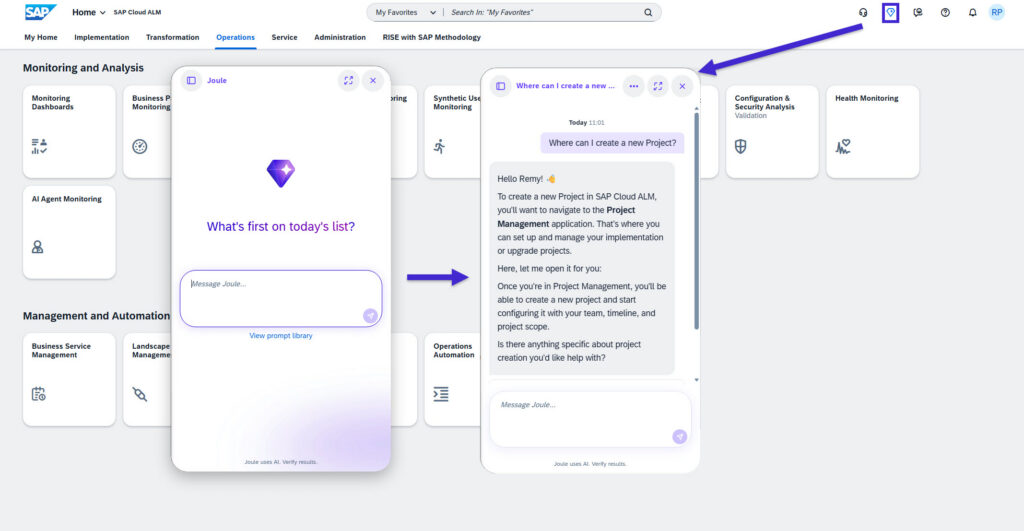
Joule brings SAP’s AI assistant into Cloud ALM. Users can ask questions in natural language, find applications and monitoring views, and get contextual guidance on features and processes. SAP uses grounding capabilities to make those answers more relevant to Cloud ALM.
These foundational capabilities reduce the time spent navigating menus and searching documentation. They are one part of a wider set of AI capabilities in Cloud ALM, which also includes specialised agents and features for operations and implementation. That distinction matters when assessing both functionality and costs.
Where AI already adds value
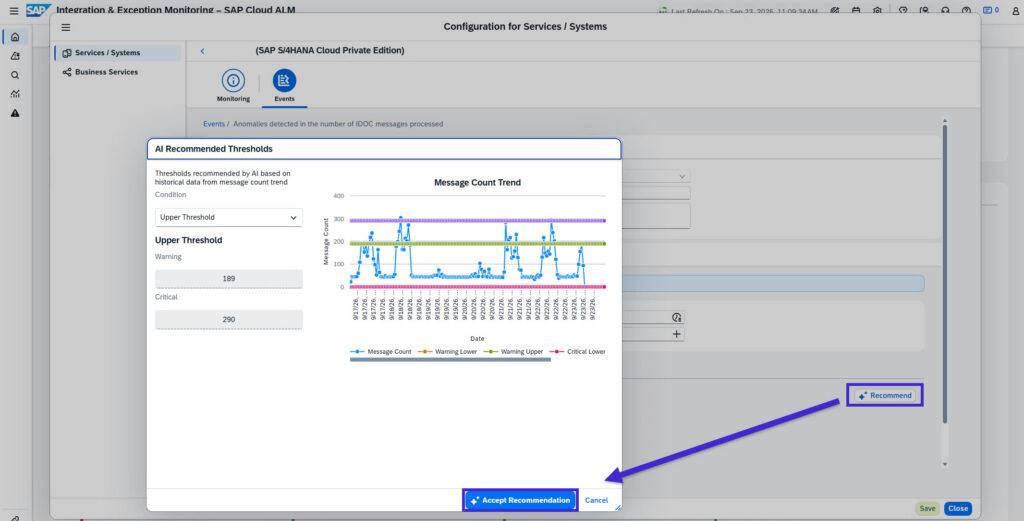
Dashboard creation is a concrete example. Rather than selecting applications, metrics and widgets manually, users can describe what they want to monitor:
“Create a dashboard showing the health of my SAP S/4HANA systems, critical jobs, failed interfaces and security related alerts.”
The Dashboard Generation Agent can create graphical cards using data from Health Monitoring, Integration Monitoring, Exception Monitoring, Jobs and Automation Monitoring, Business Process Monitoring and Configuration & Security Analysis.
AI assisted dashboards
Beyond dashboard creation, the growing range of AI capabilities in SAP Cloud ALM helps teams:
- Resolve alerts faster. Bring together AI-powered analysis, relevant context, troubleshooting steps and solution recommendations.
- Understand system health. Translate Operations Scores and KPIs into clearer insights and actionable priorities.
- Summarise documentation. Extract key information from complex documents and reduce manual review work.
- Accelerate requirements creation. Turn Fit-to-Standard workshop transcripts into structured business requirements and solution proposals.
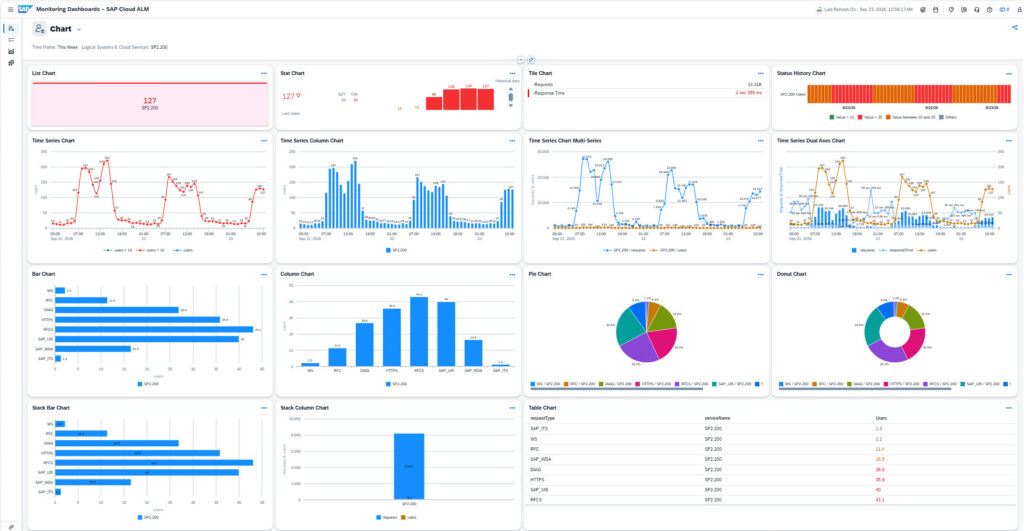
SAP is also introducing AI recommended thresholds for anomaly detection events, extending AI support into monitoring configuration.
AI recommended thresholds for anomaly detection events
For operations teams, the value lies in reducing the work between a signal and an informed response. But AI does not fix weak monitoring: poor metrics, unclear ownership and noisy alerts still need attention.
Understanding costs and AI consumption
The foundational Joule capabilities, including navigation assistance and contextual guidance, are available at no additional cost for eligible SAP Cloud ALM customers. They do not require a separate AI license or additional AI Units, and the required Joule Base entitlement is included for eligible subscriptions.
That does not mean every AI capability in Cloud ALM has the same commercial terms. More specialised or premium features may have separate licensing or AI Unit requirements. Assess the availability, entitlements and expected consumption of each capability you intend to use.
Start with the use case: what work should it reduce, who will use it and how often? Expertum can help identify relevant capabilities, estimate expected AI consumption and associated costs, and assess where the business value justifies the investment.
The foundational Joule capabilities, including navigation assistance and contextual guidance, are available at no additional cost for eligible SAP Cloud ALM customers. They do not require a separate AI license or additional AI Units, and the required Joule Base entitlement is included for eligible subscriptions.
That does not mean every AI capability in Cloud ALM has the same commercial terms. More specialised or premium features may have separate licensing or AI Unit requirements. Assess the availability, entitlements and expected consumption of each capability you intend to use.
Start with the use case: what work should it reduce, who will use it and how often? Expertum can help identify relevant capabilities, estimate expected AI consumption and associated costs, and assess where the business value justifies the investment.
From individual assistance to more autonomous operations
AI in Cloud ALM is already moving beyond information retrieval into analysis and recommendations. The next step is connecting those capabilities across an operational issue, with clear decisions about how much responsibility to delegate.
A traditional operational workflow follows:
Monitor → Detect → Investigate → Resolve
With more AI and automation, parts of that workflow could develop into:
Detect → Correlate → Understand → Recommend → Act
For example, a connected workflow could identify an abnormal background job, correlate it with application errors and failed interfaces, explain a likely root cause and recommend the next action. With appropriate authorisation and controls, selected actions could then be automated.
That final step changes the risk. Detecting and correlating signals support investigation. Recommendations need specialist judgement, while action in production requires explicit permissions, clear boundaries and human oversight.
SAP describes Joule as a foundation for future specialised agents and an evolution towards Autonomous ALM. At Expertum, we see that potential, but autonomy only makes sense when governance, security and transparency are as well designed as the automation itself.
Where we would start
Begin with a concrete operations problem where AI can save time or improve analysis. Check that the monitoring data is reliable, ownership is clear and the team understands how to evaluate the output.
Choose a limited use case, such as creating monitoring views or helping specialists investigate alerts. Then measure the result: are investigations faster, is alert noise lower and do specialists trust the recommendations? Use that evidence to decide whether to expand automation.
The goal is better SAP operations with the right balance of automation, control and human judgement. The capabilities available today give teams a way to build that experience before handing over more responsibility.