The age of Generative AI keeps making profound impact on today’s society. The current enormous investments of tech companies in AI show that it is here to stay. Particularly, SAP shows this during SAP Sapphire 2026, where they announced the Autonomous Enterprise, SAP’s strategic vision and architecture where AI agents autonomously execute end-to-end business processes in various areas. The difference here is that these AI agents do not just assist human employees, but rather automate the entire business process without human interference.
Throughout the age of AI we have seen that it is capable to drastically enhance the productivity of organizations, generating revenue and reducing costs while the workload on the existing workforce stays the same. In one example, Lemvigh-Müller currently uses AI agents for automatically reading and processing documents, allowing their workforce to focus on challenging tasks instead of reading a lot of emails from business partners. In another example, IKEA launched their chatbot Billie that handles roughly half of routine customer inquiries. Consequently, former call center employees handling repetitive tasks were repurposed to handle more challenging tasks as interior design consultants, generating a revenue of roughly 1.3 billion dollars.
These examples illustrate the potential in which AI can successfully transform organizations. Achieving success when adopting AI is not only dependent on a solid technical implementation, but also on a thoroughly functional evaluation of the corresponding AI use cases. In this blog series, we will focus on this functional side of adopting AI in projects and business processes, describing what these considerations exactly are, and providing a few tips and tricks to successfully navigate through SAP’s autonomous enterprise and other AI-solutions of SAP (and even non-SAP).
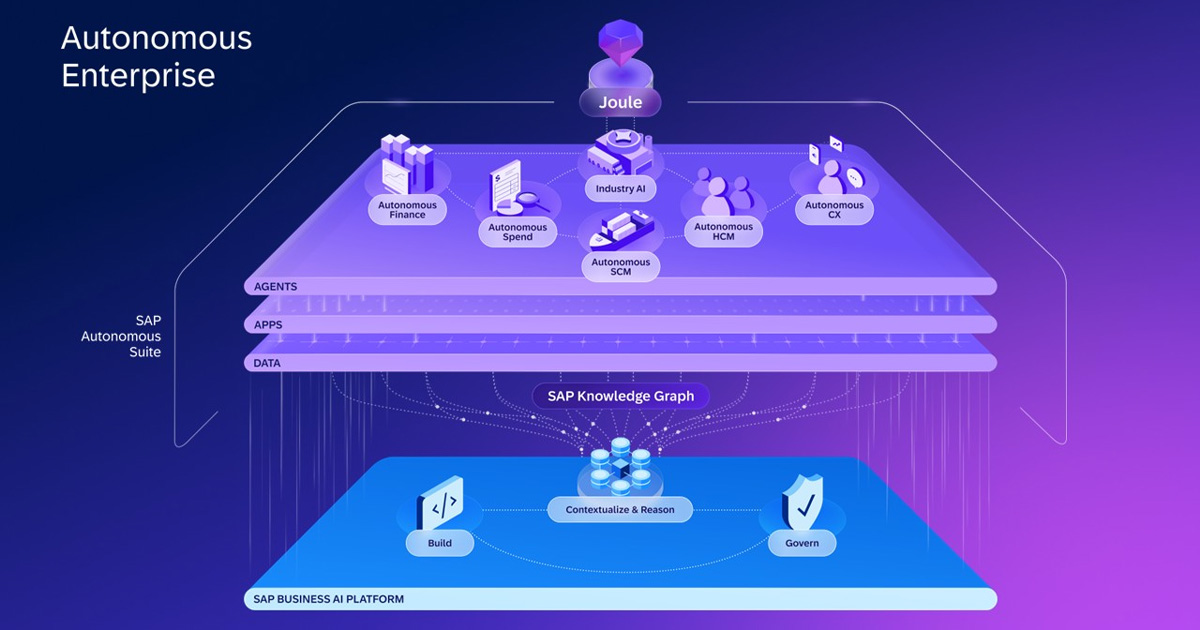
Transparency and control vs. efficiency and accuracy
Ever since the introduction of AI, a common thought has been that AI agents are never tired, work more efficiently and make fewer mistakes than humans. There is indeed some truth in this, as you can repeatedly run AI agents to perform tasks at night, while asking that from a human would be morally and legally questionable. Furthermore, AI agents can be meticulously designed to perform specific tasks and can be quite easily coordinated to perform more complex tasks (there are even agents for these coordinating tasks).
However, there is a trade-off hidden in this line of thought, and that is that while you gain efficiency and accuracy with AI agents, you lose transparency in your business process. This is because the inner mechanisms of an AI agent is invisible to users, due to the complexity of the underlying AI-models that the agents are built on. Indeed, they can be designed such that we know what it is doing, but we do not know how the agent performed the task. Solutions like the SAP Knowledge Graph or Retrieval Augmented Generation (RAG) can demystify some aspects of the thought-process of AI agents. This is because they increase the knowledge base of the AI agents, providing insight in the knowledge that is used. However, it is still not possible to trace exactly what parts of that knowledge base justifies the output of the AI agent. On the other hand, a solution designed without AI agents can always be traced back. Note that the complexity of agent-free solutions does not matter, as that simply requires more time and expertise to uncover the mechanism of such solutions.
Another trade-off is that once AI agents have been adopted you partly lose control over the solution and its corresponding business process. This is because in that case you are now more dependent on the vendors of AI agents performing those complex business tasks. Compare this with the adoption of a cloud solution, where users depend on the vendor of the cloud solution, and thus have no agency in the maintenance of the hardware where their solution is running on. This is the same concept with adopting AI agents, as the vendors determine on what data the AI agents are trained on. Should a custom business case be out of reach of the AI agents’ knowledge base, the main thing to do is to contact the vendor, who might need to retrain the agent for such business cases.
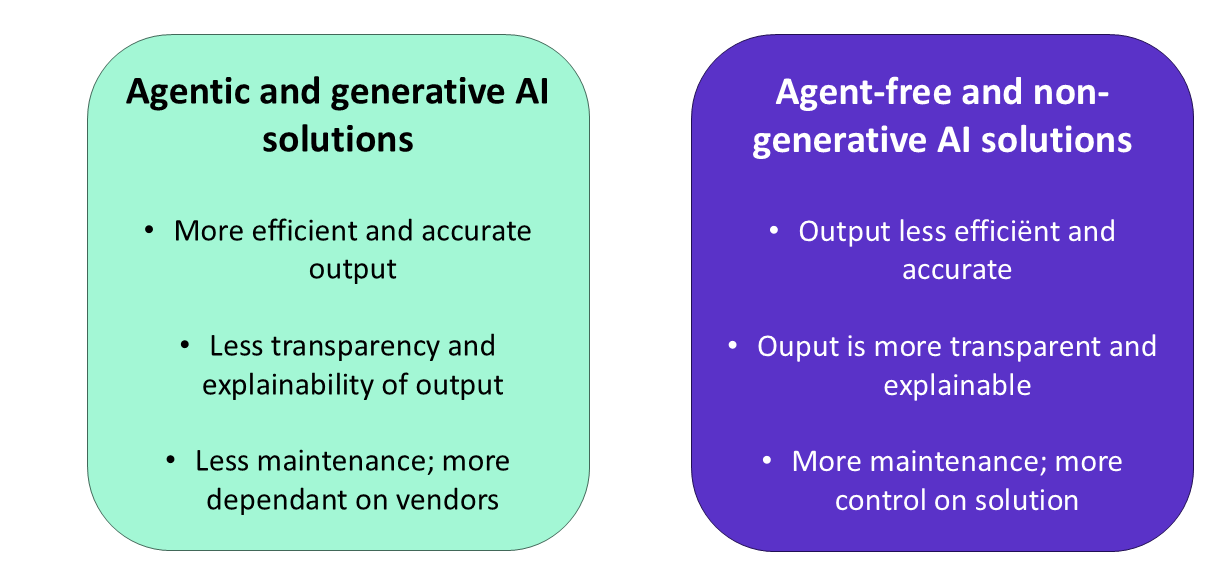
In light of the above information, one suggestion is to review to what extent the output in a business process needs to be explainable. In other words, how important is the accuracy and efficiency of the produced output compared to the need to explain it? The answer to this question determines the degree of transparency in your business process and could be a factor on whether to use AI agents or a more simpler AI model for the task.
In regards to independence and control, one consideration is to decide whether AI models and AI agents need to be maintained locally or ‘at the cloud’ by vendors. In light of the recent geopolitical unrest that the world is facing, this consideration is more relevant than ever as countries are trying to become less dependent of each other. We have seen examples where tech companies in the US can simply shutdown critical IT-infrastructure for certain people or organizations, for instance Microsoft shutting down access to email for some employees of the ICC. As such, it is currently not unthinkable that this could also be done to AI agents performing critical business tasks.
Everything is knowledge
A few years in the age of AI has made it clear that knowledge is everything. The success of adopting AI in a business process is largely determined by the amount of standardized knowledge that is available for a business process or project. In other words, the more prevalent the business process is, the less effort it requires for AI to be successfully adopted. For instance, a development project where the deliverable is an application written with standard languages like java, typescript or ABAP would be more easily picked up by an AI coding agent. Conversely, an AI agent might need more help if a custom-made consolidation tool needs to be built on SAP Analytics Cloud (SAC) with planning functionalities like data actions.
The above illustrates that the prevalence of business cases should be considered before even thinking about adopting AI in business processes. This can help in making a more accurate estimate of the monetary costs when choosing to adopt AI agents. For example, custom business cases usually require the maintenance of company specific data and more advanced AI features in order to design and ground AI agents successfully. Knowing this beforehand could make a significant difference in the cost estimate and the effort needed to prevent AI agents from making mistakes.
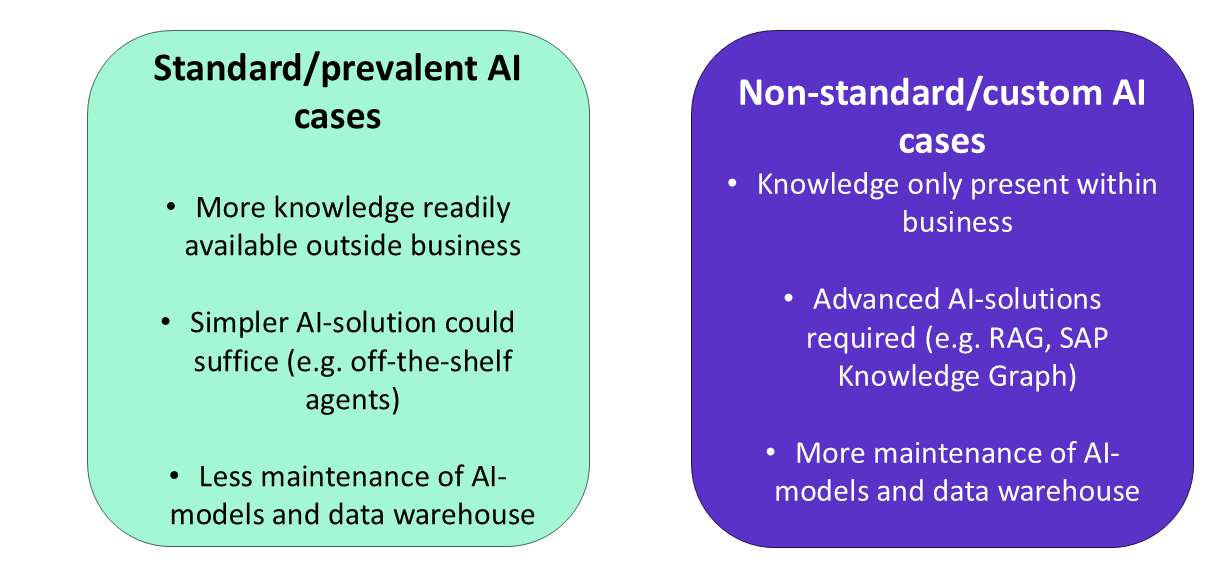
Given the aforementioned information, one tip in adopting to AI is to align your business case with standard and more prevalent use cases as much as possible. The more that the business case is standardized, the less effort is needed for adopting AI solutions. This is because the possibility of potentially using off-the-shelf AI services and AI agents increases for such business cases.
For more unique and non-standard business cases, off-the-shelf AI features and AI agents won’t suffice. Instead, more advanced and complex solutions like RAG should be used to ground an AI agent with specific business data. Other solutions like the SAP Knowledge Graph and the Generative AI Hub can also be used in order to develop custom applications for your business process.
AI is not cheap, both economically and environmentally
Speaking of costs, a few years in the age of AI has shown that AI-solutions are not cheap. Given that the investments by big tech companies in AI are colossal, this money needs to be made back in some way. Add that to the fact that the price of critical computer hardware like Graphical Processing Units (GPUs) and memory chips are at an all-time high due to the demand of AI, and that AI-models themselves require a large amount of storage and processing power, and the result is that adopting AI-solutions might not be cost-reducing as they seem.
But making these estimates is already an effort on its own. In fact, a standardized estimation method does not exist due to the fact that every AI case is unique on its own, either by the flow of the business process or the data that is used and processed within the organization. Quantifying the usage of AI agents or AI models is mainly done through tokens, and this will mainly be a rough estimate for any AI case. Furthermore, not all token types are the same, as for instance input tokens (i.e. tokens that you send to a model) are usually cheaper than output tokens (i.e. tokens returned by the model).
The costs of AI-solutions are not limited to just monetary costs. In fact, as the age of AI progresses the environmental costs of AI are becoming increasingly clear. One of those ecological costs includes the large amount of energy (i.e. electricity) that is needed to train and maintain AI models and AI agents, which currently are mostly coming from fossil fuels. Another environmental cost of AI is the amount of water that is needed to cool data centers, which are essential parts of the infrastructure of AI-solutions. As we are currently experiencing the consequences of climate change more directly, these environmental costs of AI are becoming more relevant in the functional discussion of adopting AI solutions.
The aforementioned information shows us that AI, while effective and capable of positively transforming your business, is not a cheap solution. Therefore, evaluating the value that adopting AI in your business process creates should be considered carefully in your AI case. This value is not only limited to revenue and profit, but also the reduced time and effort to perform tasks with the same workforce or the elimination of repetitive and error-prone tasks. This is different for each business case, and as such a standardized answer to this question is not present.
Conclusion
In this blog, we have mentioned a few functional aspects that could be encountered when designing and implementing AI in your business. AI is rapidly improving as we speak such that some have recently called for a pause in its development. Nevertheless, as AI solutions are maturing over time, the above functional aspects is a tentative list since more of those aspects will emerge. So stay tuned for the second part of this series, where we take a deep dive into how to handle errors once AI agents have been adopted, and how AI can be used to transform the purpose of the workforce.